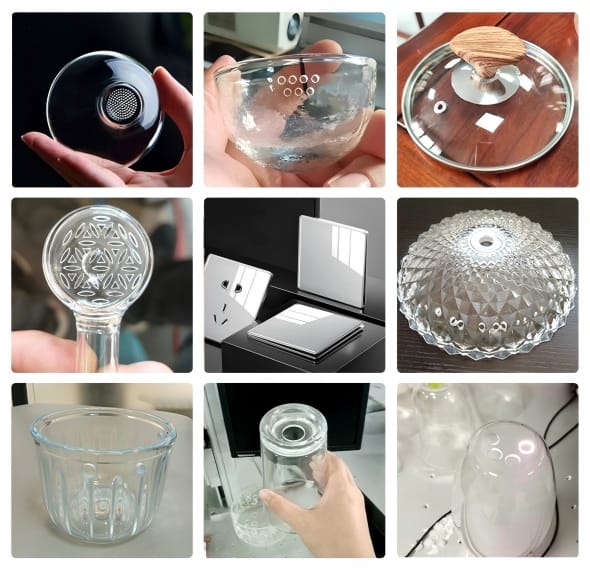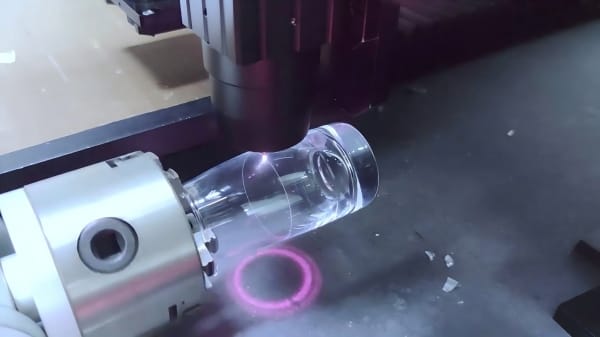
Short answer: Yes. And laser drilling is not only feasible – it is becoming one of the mainstream technologies for precision glass processing.Whether it is laboratory glassware, wine bottles, perfume flacons, optical glass, or smartphone screen glass, lasers can drill micron precision holes. However, glass is a “delicate” material – hard yet brittle, poor thermal conductivity, and extremely sensitive to thermal stress. Laser drilling of glass is essentially a technical challenge of precisely controlling heat.
- Why Can Lasers Drill Glass? What’s the Principle?
The main component of glass is silica (SiO₂). Unlike metals, glass does not have free electrons to absorb light energy, nor does it ablate easily like wood. The core principles for laser glass drilling include:
- Thermal Ablation
A high energy laser beam is focused on the glass surface, raising the local temperature instantly to thousands of degrees Celsius, melting or even vaporising the material to form a hole.
Lasers used: CO₂ laser (10.6 μm wavelength), fibre laser (1.06 μm)
Challenge: Glass conducts heat poorly; heat tends to accumulate locally, creating thermal stress that leads to cracks, edge chipping, or even complete shattering. This is the biggest pain point of traditional laser glass drilling.
- Multi photon Absorption
Ultra short pulsed lasers (picosecond, femtosecond) have extremely short pulse widths (1 ps = 10⁻¹² s) and extremely high peak power. Glass is transparent at conventional wavelengths, but under such high energy density, non linear multi photon absorption occurs. Energy is deposited only at the focal point, leaving the surrounding material virtually unaffected.Lasers used: Picosecond and femtosecond lasers (often with green or UV wavelengths)Advantage: “Cold processing” – nearly zero heat affected zone (HAZ), smooth edges, no micro cracks, and micron level precision.
- Laser induced Etching
First, the laser modifies the glass (internally or on the surface) to create micro cracks or chemically active regions, then acid etching or subsequent processing enlarges the hole. This method is suitable for large or non circular holes.
- Comparison of Different Laser Types for Glass Drilling
| Laser Type | Wavelength | Capable? | Performance & Applications |
| CO₂ laser | 10.6 μm | ✅ Yes | High absorption by glass; good for large holes & rough processing, but significant heat impact and edge chipping |
| Fibre laser | 1.06 μm | ⚠️ Limited | Glass is largely transparent; low absorption – usually requires an absorbing coating or high power; average results |
| Green laser | 532 nm | ✅ Yes | Moderate absorption; suitable for medium precision drilling |
| UV laser | 355 nm | ✅ Recommended | High photon energy directly breaks chemical bonds; “cold” effect; excellent for fine micro holes |
| Picosecond / Femtosecond laser | Various | ✅✅ Best | Ultra short pulses, no thermal damage, highest edge quality; ideal for precision optical glass and micro hole arrays |
- Real World Applications
- Laboratory Glassware
Drilling micro holes in beakers, measuring cylinders, and reaction vessels for aeration, sampling, or tubing connections. Laser drilling is non contact, avoiding contamination and stress induced breakage associated with mechanical drilling.
- Wine & Perfume Bottles
Creating decorative holes or functional small apertures (e.g., spray nozzle mounts) on high end bottles. Lasers enable arbitrary patterns with smooth edges, enhancing product aesthetics.
- Smartphone Screens & Cover Glass
Camera holes, earpiece openings, and sensor apertures – typically 1 3 mm in diameter – demand extremely tight edge chipping (often <50 μm). This is almost exclusively achievable with picosecond or UV lasers.
- Optical Components
Positioning or through holes on filters, prisms, and lenses require zero chipping and zero cracks – only ultra fast lasers can meet this standard.
- Bio chips & Microfluidics
Drilling micron scale channels in glass substrates for DNA sequencing, cell sorting, etc. Holes may be just tens of microns across with smooth inner walls – mechanically impossible.
- Laser Drilling vs. Mechanical Drilling: The Showdown for Glass
| Comparison | Mechanical Drilling | Laser Drilling |
| Contact | Physical, drill bit required | Non contact, no tool wear |
| Minimum hole diameter | Typically >0.5 mm | Down to 10 μm or even smaller |
| Edge quality | Prone to chipping & micro cracks | Ultra fast lasers achieve “zero chipping” |
| Thermal impact | Mechanical stress – may shatter | Ultra fast lasers have virtually no thermal effect |
| Non circular holes | Extremely difficult | Any shape, software controlled |
| Processing speed | Fast for single holes, but slow tool change | High speed scanning, suitable for batch micro holes |
| Thick glass | Clear advantage | Deep hole drilling is challenging, requires specialised techniques |
Conclusion: For large holes and thick glass (>10 mm), mechanical drilling still holds a cost advantage. But for micro holes, precision apertures, and shaped holes, laser is irreplaceable.
- Key Considerations When Laser Drilling GlassIf you plan to laser drill your own glass cup or bottle, keep these points in mind:
Choose the right laser type: A standard CO₂ laser can drill glass but is only suitable for rough or decorative work. For precision small holes, you must use UV or picosecond equipment.
Control power & speed: Too high power or too slow speed will crack the glass. Typically, multiple low energy passes are better than one intense blast.
Auxiliary measures:
* Apply wet tissue or black ink on the surface to improve CO₂ laser absorption.
* Use compressed air or inert gas to blow away molten debris and prevent re solidification blocking the hole.
* Pre heat or anneal the glass to reduce thermal stress.
Glass type matters: Soda lime glass (common windows, wine bottles) cracks more easily than borosilicate glass (heat resistant, labware) – so parameters must be adjusted.
Thickness limitation: Laser drilling works best for 1 6 mm thickness. For thicker glass, energy attenuates significantly with depth, resulting in large taper or incomplete penetration.
- Summary
Lasers can absolutely drill holes in glass cups or bottles, and the technology is already mature. From industrial grade picosecond micro hole processing to workshop level CO₂ decorative engraving, there is a solution for every need.
The key is not whether it can be done, but what size hole you need, how precise it must be, and how much you are willing to invest. If you just want a DIY decoration on a glass bottle, a standard CO₂ laser engraver will do the job. But if you need a micron scale through hole with zero chipping in optical glass, you will need a million dollar ultra fast laser system.
Glass is an ancient material; laser is a modern tool. When they meet, even brittle glass can bloom with the precision “flower of light.”
If you are considering laser processing for glass products, we recommend first clarifying the hole size, glass material, and accuracy requirements – then choosing the right laser equipment or processing service provider.