I. Comparison of Technical Principles
Waterjet Cutting Technology
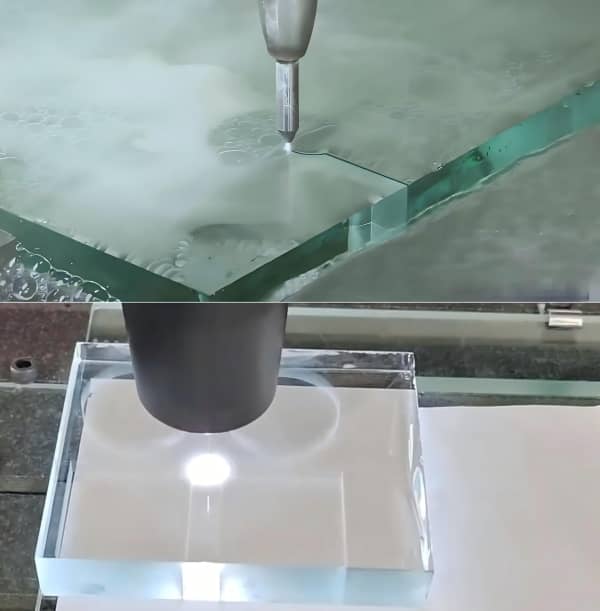
Waterjet cutting utilizes a high-pressure pump to pressurize water to levels exceeding 380 MPa; through an extremely fine nozzle (0.1–0.3 mm), this process generates a high-speed water jet (with velocities reaching up to 900 m/s), which then impinges upon the glass in combination with abrasive particles such as pumice sand to achieve cutting. Its core characteristic is cold-work processing—no heat is generated during the cutting process, thereby preventing thermal stress-induced deformation or the propagation of microcracks in the glass.
Technical parameters:
- Cutting pressure: 380–600 MPa
- Cutting speed: 300–600 mm/min (depending on thickness)
- Cutting accuracy: ±0.1 mm
- Maximum cutting thickness: up to 200 mm
Laser cutting technology
Laser cutting primarily operates on two principles:
- Thermal stress cutting: generates controllable cracks through localized heating
- Ablative cutting (ultrashort-pulse lasers): picosecond/femtosecond lasers directly break molecular bonds.
Modern laser systems typically feature multi-wavelength laser sources at 1064 nm, 532 nm, and 355 nm, which, via a precision optical system, focus to generate micron-scale spots (with a minimum size of 10–20 μm).
Technical parameters:
- Cutting accuracy: ±0.01 mm
- Minimum cutting gap: <0.1 mm
- Drilling speed: 100 holes/minute (diameter: 1 mm)
- Applicable thickness: 0.1–20 mm (depending on glass type)
II. Performance Comparison Analysis
| Comparison Dimensions | Waterjet cutting | laser cutting |
| Cutting accuracy | ±0.1 mm; incision width: 0.1–1.8 mm | ±0.01 mm, minimum cut seam <0.1 mm |
| cutting speed | 300—600mm/min | Can reach several meters per minute |
| Thickness capability | Up to 200 mm | Typically ≤20 mm |
| Edge Quality | Fair condition, but shows abrasive impact marks. | Excellent; edge distortion <30 μm |
| heat affecting | No heat-affected zone (cold cutting) | Ultrafast lasers exhibit virtually no thermal effects. |
| Environmental Friendliness | Wastewater generated must be treated. | Pollution-free; only a small amount of gases require purification. |
| Equipment Cost | Low (approximately 60–70% of laser equipment levels) | Relatively high, especially for ultrafast laser systems. |
| Consumable costs | Requires continuous consumption of water and abrasives | High power consumption; no material consumption. |
| complex shape | Suitable for large-sized complex contours | Suitable for fine and complex patterns |
Ⅲ. Specialized Comparison of Drilling Capabilities
Waterjet drilling characteristics
- Pore size range: 1–60 mm
- Drilling speed: approximately 30 seconds for a hole with a diameter of 10 mm
- Advantages: Suitable for drilling through thick glass (>20 mm).
- Limitations: It is difficult to ensure the precision of small holes (<1 mm), and conicality issues may arise.
Characteristics of laser drilling
- Pore size range: 0.2–10 mm (minimum achievable: 0.1 mm)
- Drilling speed: Up to 100 holes per minute for holes with a diameter of 1 mm.
- Advantages: Micro-pore array fabrication offers high processing efficiency and excellent pore wall quality.
- Limitations: Drilling through thick glass (>10 mm) is highly challenging.
IV. Applicable Scenarios and Selection Recommendations
Scenarios where waterjet cutting is preferred
- Ultra-thick glass processing: architectural glass, bulletproof glass, etc., with thicknesses exceeding 50 mm
- Composite material cutting: e.g., glass–metal sandwich materials
- Large-sized workpieces: architectural glass requiring a machining platform of 2m × 4m or larger
- Budget-constrained projects: lower equipment investment and maintenance costs
Scenarios where laser technology is preferred
- Precision Electronic Glass: Micro-machining for mobile phone covers, display screens, etc.
- Batch-scale standardized production: requires high-efficiency pre-cutting of automotive glass
- High-value-added products: sectors requiring extremely high precision, such as optical components and medical glass.
- Strict environmental protection requirements: a production environment with no discharge of wastewater or exhaust gases.
Hybrid Technical Solution
The emerging water-guided laser technology combines the advantages of both approaches:
- Laser transmission via a 300–600 MPa water column
- Heat-affected zone <10 μm
- The fiber fracture rate was reduced by 70%.
- Particularly suitable for the processing of glass fiber composite materials
V. Industry Application Cases
- Building curtain wall glass: waterjet cutting for custom contours (thickness: 15–25 mm)
- Smartphone cover plates: UV laser cutting of 2.5D/3D curved glass
- Car sunroof: waterjet pre-cutting + laser-finishing of edges
- Optical lenses: femtosecond laser machining of microstructures (precision ±1 μm)
- Art Glass: Waterjet carving for heavy glass, with laser processing for intricate details
VI. Future Development Trends
- Widespread adoption of ultrafast lasers: picosecond/femtosecond lasers will resolve the thermal effects associated with traditional lasers.
- Intelligent Upgrade: The AI-based adaptive parameter optimization system improves the yield rate
- Hybrid Machining System: A composite machining center featuring the synergistic operation of waterjet and laser technologies
- Green Manufacturing: Waterless laser cutting technology reduces the environmental footprint 8
When making a selection, it is essential to comprehensively consider factors such as material properties, thickness requirements, precision standards, production batch size, and budget constraints; for critical applications, it is recommended to conduct a sample trial-cut evaluation to assess the actual performance.